Acetabulum (ACT): A portion of the pelvis with the full acetabular socket and labrum attached.
Humerus (HUM): This bone is harvested fully intact. One per harvest.
Fibula (FIB): This bone is harvested fully intact one per harvest.
Patella (PA): This sesamoid bone measures 2.2 cm in thickness and the cartilage measures 5 mm in thickness. The patellar and quadricep tendons are attached.
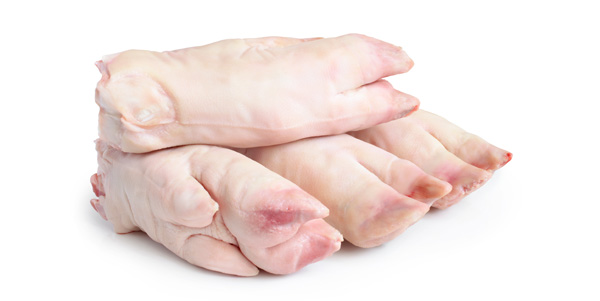
Front feet (FF): The front foot of the pig that includes the skin, muscle, and phalanges.
Femur (FEM): Femur bone with all condyles attached. Muscle tissue is dissected away from the bone unless specified.
Head (HD): The head with or without ears and eyes attached. Skin and muscle are attached.
Skull (SKL): Skull with brain intact. The muscle and skin are removed. The mandible is removed.
Legs Front (LF): Full front legs including ulna and radius (both cut just above the carpals), carpals, metacarpals, phalanges. Skin and muscle attached.
Legs Hind (LHHH): Includes the tibia and fibulas (both cut just above the tarsals), tarsals, metatarsals, and phalanges with muscle and skin attached.
Lumbar Spine (LVBRT): Lumbar vertebrae L1-L5 cut in half on the sagittal plane. This tissue consists of ½ spine. The vertebral discs (1/2s) are in place. The spinal cord is not part of this tissue.
Thoracic Vertebrae (THVRT): The thoracic spine (T1-T12) is cut on the sagittal plane and the spinal cord is removed. The vertebral disc is in place (again with the sagittal cut). This tissue provides ½ of the vertebral column.
Rib Section (RB): Includes ribs with a cut through the vertebral column and the sternum on the sagittal plane, intercostal muscles, and costal cartilage. T-1 – T12.
Rib Section with Body Wall attached (RBWBW): The ribs T1-T12 with a sagittal cut through the sternum and vertebral column, intercostal muscles, and costal cartilage all covered with the skin, muscle, fat, and fascia.
Tongue (TON): The entire tongue is harvested up to the base. There is no extra muscle attached.
Mandible (MAN): The domestic pig mandible is a custom harvest which means the skin and muscle are optional. The molars are intact as is the gingiva.
Scapula (SCA): One piece.
Stifle Joint (STFL): Included in this tissue is the femur (which is cut mid-shaft), the tibia and fibula (which are cut mid-shaft of both bones), the patella, and meniscus pairs as well as all the ligaments within the joint. The muscle and skin are attached.
Stifle Joint – Dissected (STFLD): Included are the femur, tibia, and fibula (all of which are cut mid-shaft), the patella and meniscus pairs, and the ligaments involved in the joint. The skin and muscle have been dissected away to reveal the joint.
Tibia with Condyles (TIBC): This bone is harvested with the condyles attached.
Tibia without Condyles (TIBCR): This bone is harvested without the condyles. It is cut just below them.
Body wall (flank)(BW): This tissue includes all tissues from the epidermis to the peritoneum. The sheet of tissue is harvested from dorsal to ventral and from scapula to pelvis. Included are the epidermis, dermis, fat, fascia, and muscle. The tissue sheet measures approximately 12”x 20” and is approximately 1” thick.
Body Wall Cut (BWC): This tissue is the same description as the body wall except for it being cut into smaller custom sized pieces as per client specifications.
Diaphragm (DIA): Full diaphragm with openings of aorta hiatus, esophageal hiatus, and caval opening present. There is a cut opening in the frontal portion of the diaphragm which makes the tissue in the shape of a “C”.
Longissimus Muscle (LM): This muscle is also known as the loin and is harvested as a single.
Skeletal Muscle (SKM): Clients may specify which skeletal muscle they prefer. All are available.
Costal Cartilage (CC): Harvested from the ribcage (1/2 of rib cage) between the ribs and the sternum.
Ear (EAR): Individual ear with skin attached. Tissue will be free of hair and may have ear notches used for identification. The ear is harvested at the base of the pina just before it meets the head.
Fibrocartilage (FBC): Harvested from the spinal column or the stifle joint.
Meniscus (MEN): Medial and lateral meniscus of the stifle joint.
Nasal Septum (NS): Harvested measurement is 4 inches long, 1 mm thick, and 25 mm wide
Achilles Tendon (TNA): This tendon is harvested at a length of 5” and has an inner lumen round diameter of 1 mm.
TNA Extensor Tendon (TNE): This digital extensor tendon is harvested from the front leg of the pig and has a harvested width of 1” and length of 2”.
Flexor Tendon (TNF): This digital flexor tendon is harvested from the front leg of the pig and has a harvested length of 1” and a round diameter of 1⁄2”.
Porcine musculoskeletal tissues are used in research because they closely resemble human bone, cartilage, muscle, tendons, ligaments, and joints. Their natural structure and mechanical properties make them useful for preclinical studies, device testing, and surgical training.
Compared to synthetic models, porcine tissues provide:
These qualities make porcine tissue especially valuable when tactile feedback, movement, and mechanical performance matter. ABI provides ethically sourced porcine tissue using controlled harvesting, handling, and delivery protocols.
Porcine musculoskeletal system tissue is used for medical research, surgical training, orthopedic device testing, and product development. These tissues can help researchers and clinicians study bone, cartilage, muscle, tendons, ligaments, joints, and related anatomical structures in a realistic biological model.
Yes. Porcine bone, cartilage, and joint tissues are commonly used in preclinical orthopedic research because they offer realistic density, structure, and mechanical behavior. They can be used to evaluate screws, plates, implants, fixation methods, and other orthopedic devices.
Yes. ABI can provide custom harvest options based on study requirements. Researchers may request specific bones, joints, muscle groups, tendons, ligaments, or connected anatomical structures. Preparations can often include or exclude skin, muscle, fat, fascia, or surrounding tissue depending on the application.
Yes. Porcine mandibles, jaws, skulls, and teeth are often used in dental, maxillofacial, and craniofacial research. These specimens can support surgical training, implant testing, dental device evaluation, and anatomical studies.
Porcine tissues are harvested post-mortem under controlled conditions and processed promptly to help preserve usability. Temperature-controlled packaging, cold packs or dry ice, and coordinated delivery timelines help maintain tissue integrity during transport.
Available musculoskeletal tissues may include bones, joints, muscle, cartilage, tendons, ligaments, rib sections, vertebrae, mandibles, skulls, feet, and other anatomical preparations. Custom tissue blocks or combined anatomical sections may also be available for more complex research needs.
Musculoskeletal tissues are commonly used in scheduled surgical labs, orthopedic device validation, and preclinical research programs. Early coordination helps ensure proper anatomical specifications, consistent tissue quality, and delivery timing aligned with your study or training schedule.
To discuss custom harvesting options or arrange delivery, visit our Contact page to connect with the ABI team.
Browse our available tissues by category, or access a PDF of the complete catalog here.
For an alphabetical list of our available tissues, please click here.