

Porcine tissue research continues to expand in numerous directions. One of the most interesting is undoubtedly its potential to improve vascular tissue engineering and regenerative medicine research.
While not as headline-grabbing as topics like xenotransplantation, researchers have been quietly making big advances in using decellularized porcine tissue to aid human healing. Animal Biotech Industries is proud to support these efforts with our precisely-harvested, ethically-sourced post-mortem porcine tissue.
How can swine products aid in vascular tissue engineering and extracellular matrix research? Here’s what the field looks like at the end of 2025.
I. What Does Extracellular Matrix Research Focus On?
The extracellular matrix (ECM) is a complicated system of proteins and carbohydrates that are excreted by cells as a support system. The ECM aids in a wide variety of functions, including cell communication, movement, and – most relevant here – repair.
When tissue takes damage, the ECM could be seen as constructing a sort of scaffold that guides tissue repair. The problem is, the more traumatic the damage, the more difficult this process becomes. This slows healing and increases the chances of comorbid factors such as infection.
So, finding ways to support and speed up the healing of such wounds is of great interest to researchers. However, the matter is complicated in several ways.
Each cell or tissue type tends to have a unique ECM composition, and the ECM directly influences cell growth/regrowth. So, any attempt to modify or replace the ECM cannot impede or sabotage cell regrowth. Further, there are immunological considerations. Any outside aids must be accepted by the body, as immune rejection would only cause more damage.
In recent years, study has turned towards the use of decellularized donor tissue, such as post-mortem porcine lung tissue, as a source of donor ECM. Decellularized ECM (dECM) has great potential to aid in injury recovery, especially if methods can be found to prevent rejection while properly aiding tissue regrowth.
II. How is Decellularized ECM Created?
The decellularization process involves stripping the donor tissue of its immunogenic cellular components – such as DNA – which can trigger immune responses in recipients, while still preserving the underlying ECM structure.
Per the Journal of Functional Biomaterials in 2025, the current most common way of achieving this is through “ionic detergents such as sodium dodecyl sulfate (SDS), sodium deoxycholate (SDC), and Triton X-100,” which are highly effective at removing cellular components. However, the article notes that the detergents must be precisely applied to avoid binding with the remaining cells and causing cytotoxic effects.
Still, ionic detergents are seen as preferable to less aggressive methods that often fail to properly scrub the tissue of genetic material, requiring multiple processes to complete the decellularization.
In particular, this ionic detergent process is cited as highly successful on post-mortem porcine tissue in a 2025 Biomaterial Advances article. In the documented experiment, they were able to create dECM material suitable for human cardiovascular repair from porcine liver.
This is one of the reasons swine are now becoming a common source for biomedical scaffolds.
III. Why Choose Porcine Tissue For Biomedical Scaffolds?
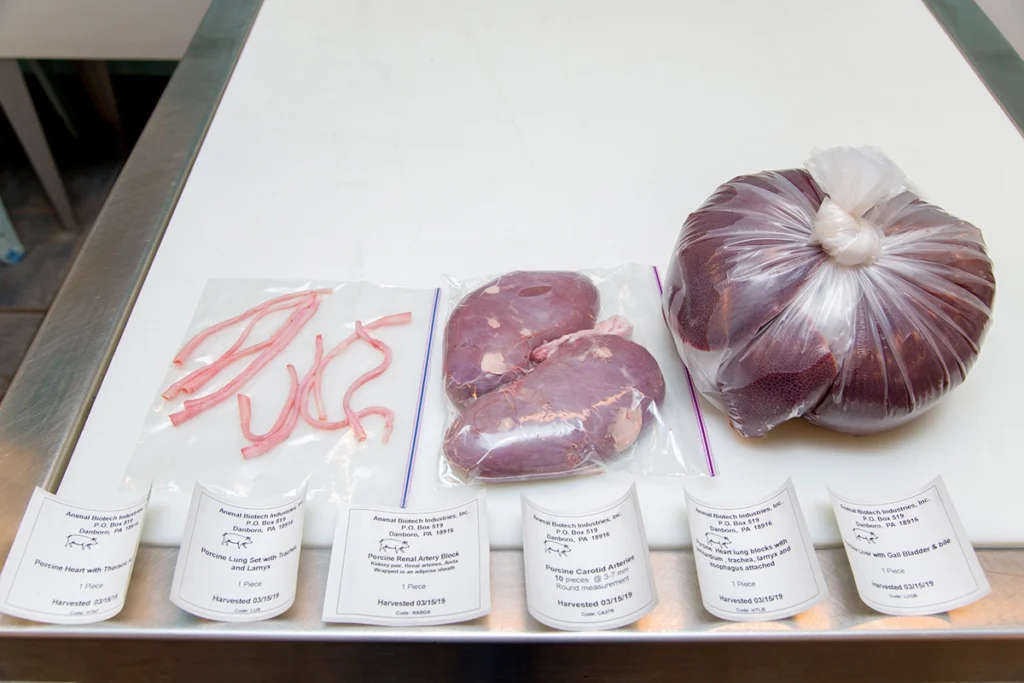
In general, swine have been noted for having a biology remarkably similar to humans, even more so than species one would expect to be a close match, such as great apes. From genetic components to basic organ size and function, swine organs and tissues are already a close match to humans.
This has made swine one of the most popular sources for human medical research, in applications ranging from skin grafts to corneal replacement.
The same is holding true for the use of porcine-derived tissue engineering scaffolds and other dECM applications. In 2022, a Modern Technologies in Medicine article cited multiple successful uses of porcine-derived dECM including replacing joint cartilage, as well as noting it was currently the most popular source of dECM materials.
At least one study – published in Biomaterials Science – even found that porcine materials produced superior results to human-derived alternatives for injectable biomaterial.
Synthetic materials are another alternative for creating ECM scaffolds, but come with their own issues. They struggle due to their lack of bioactivity and a tendency to provoke immune responses. As described in a separate J Funct Biomater article, “porcine-derived scaffolds strike a balance between biologic performance and clinical manageability.” However, the article does note that synthetic ECM scaffolds do have some advantages in strength and flexibility.
IV. What Other Benefits Do Swine Tissues Bring to dECM Research?
There’s also the matter of availability. Human-derived donor material is always difficult to come by, and demand frequently outpaces supply, often by a high degree. In all likelihood, there will always be fewer donors than people in need of donated human tissue.
Meanwhile, swine are among the most farmed, bred, and researched animals on Earth. They are easily available to researchers and medical facilities worldwide, which also makes them inexpensive to source as well. There is no risk of running low on porcine tissue.
So, whenever swine tissue can be profitably used for human medical research, it makes sense to utilize a less expensive and easily-renewable source – especially when partnered with a company that can guarantee reliable medical-grade materials.
Animal Biotech Industries Is Your Partner For Post-Mortem Porcine Tissue
Since 1990, ABI has been one of America’s leaders in supplying porcine tissue for any research or medical applications involving an ex vivo animal tissue model. We’ve built our company on a foundation of accuracy, ethics, and a strong focus on customer satisfaction.
Our management is comprised of highly-trained specialists, including published researchers, focused on accurately harvesting the best tissue for your needs from well-vetted and sourced swine. We only source animals that have been humanely raised and euthanized, to maintain high ethical standards in all the work we support.
Likewise, our packaging is focused on being either biodegradable or reusable, while still delivering your materials properly contained and in a rapid fashion. Next-day delivery is available on demand, and in some cases, same-day delivery may be arranged.
You can also leverage our expertise in your own work. Do you need advice on how to best conduct porcine tissue research, or the best materials for your particular case? Our staff is on-call to assist with solving difficult problems while providing the best in swine tissue.
For more information on how vascular and circulatory tissue models support device evaluation and hands-on training, read our related blog on how porcine circulatory tissues are used in medical device testing and surgical training.
To learn more or request advice, just contact us here. Or, click here to browse our full catalog of post-mortem porcine tissue.