
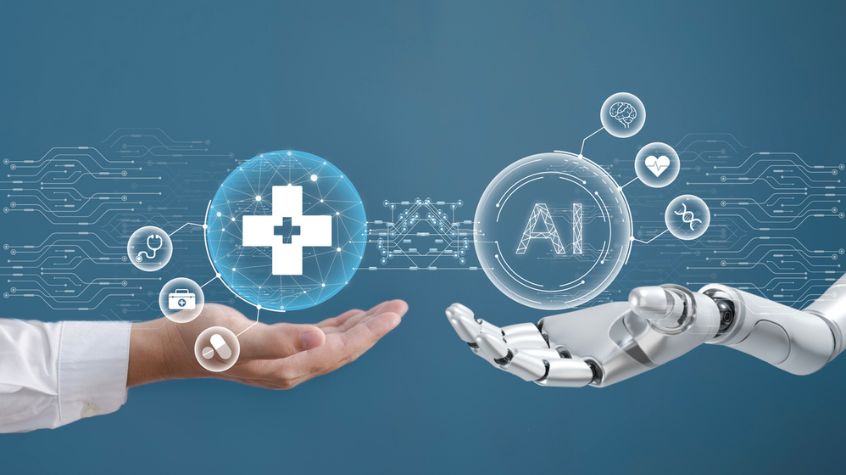
Are the limits of AI in biomedical research being properly addressed?
Right now, one of the biggest and most controversial topics in biomedical research is Artificial Intelligence. Modern AI systems, based on Machine Learning (ML) models, are being increasingly used in speculative research.
This has led to some genuinely interesting discoveries, such as discovering more genetic basis for autism spectrum conditions. AI in medical device development shows similar promise, such as the development of an AI-powered wristband capable of monitoring for heart disease. AI is also being explored for its potential to speed up the processing of data and the creation of publication-ready research materials.
However, there are still numerous issues with AI in biomedical research, which are perhaps being overlooked in the current ‘gold rush’ environment. More critically, there are hard limits in what AI can accomplish. There is a barrier between theoretical AI models and practical real-world testing, which will likely never go away.
To be clear, we are not anti-AI; any research that improves human medicine is welcome. However, we know that the potential drawbacks and challenges facing AI medical research must be discussed. So, in this article, we’ll look at some of the biggest issues with current AI research and why real tissue testing using actual animal materials remains vital.
In Silico vs In Vitro Research – Can a Computer Model Cellular Activity?
It’s easy to understand the appeal of computer models. If a computer could accurately simulate a complicated biological process, sometimes called “in silico” research, then research could be accelerated. Better yet, it would require less use of animal or human test subjects, making it a theoretically superior ethical choice.
Unfortunately, there are limits to how far this could go. Due to the complexity of cells and biological processes, computational biology has its limits. A 2021 PNAS article estimated that it would be decades, if ever, before computers were capable of fully simulating multicellular systems.
Further, that assumes biological processes operate according to a standard model. While currently under debate, recent research suggests that quantum effects may be involved in biological processes. If true, that would imply that perfect in silico models may be practically impossible, even with quantum computing.
In short, while AI has proven effective at analyzing large existing data sets, its predictive abilities may be severely limited.
The Black Box Problem – What’s That AI Doing, Anyway?
Another major issue exists, as discussed in Biomaterial Medical Devices in 2023 – the “black box” nature of AI reasoning. Simply put, the way current Machine Learning models work is extremely fuzzy. It is often difficult or impossible to understand exactly why or how an AI model came to a certain conclusion.
Unlike a grad student or junior researcher, you cannot ask an AI to explain its ‘thought process’ step by step to analyze its reasoning. Current AI systems based on Large Language Models (LLMs) are incapable of that sort of self-reflection.
Worse, in some cases, it’s possible to feed the same data into the same AI and have it reach two different conclusions. Again, with no reasoning to analyze.
This could have a significant impact on the ability of researchers to turn AI insights into real-world research utilizing real tissue testing, much less live subjects. No translational research tools exist that can turn a ‘black box’ discovery into a research proposal that appears to have a firm basis. At best the research would be purely exploratory, effectively saying, “The AI thinks this is a good idea, so let’s give it a shot.”
Such proposals may be viable with basic tissue-based research methods involving post-mortem materials, but would still face heightened scrutiny. If a researcher is unable to explain how a proposed outcome might occur, research will be slowed.
How Can Potential Biases of AI in Biomedical Research Countered?
Another important issue raised by the above Biomed Mater Devices article is the problem of human biases slipping into AI research. We like to think of computers as being impartial, and they are in some ways.
However, an AI is only as unbiased as its data set. Online retailer Amazon discovered this the hard way a few years ago, when a system set up to analyze resumes in hiring began discriminating against women. Because many resumes fed to the system were from men, the system took this to mean that male candidates were preferable.
Likewise, medical data can skew along racial lines. Black women have a 38% higher fatality rate from breast cancer than white women, yet they only represent five percent of research subjects. This undoubtedly influences research outcomes.
An ML AI may be completely incapable of recognizing these bias issues. Thus, without rigorous data scrubbing and validation far beyond current standards, human biases will still creep into AI analyses.
Real Tissue Testing Will Always Be Needed for Translational Research
This is all to say: AI has great potential for improving certain areas of medical research, but it will likely never replace hands-on tissue-based research methods. An AI may be able to deliver interesting new insights, but robust real-world testing is needed – such as with porcine tissue research models.
Swine tissue is still the best option for animal research with human applications. More valuable research is still being done with porcine materials than with AI, and that seems unlikely to change any time soon.
American Biotech Industries is among America’s most-trusted sources of research-grade postmortem swine organs and other tissue. Our animals are ethically raised and harvested, shipped to you in environmentally friendly packaging. Our on-staff experts include published researchers, and we are always available to consult on research-related issues or help you select the best swine tissues for your needs.
With next-day shipping available in nearly all cases, and same-day shipments often possible, ABI is here whenever you need us.
Please click here to browse our full tissue catalog, or contact us directly for questions or special requests.